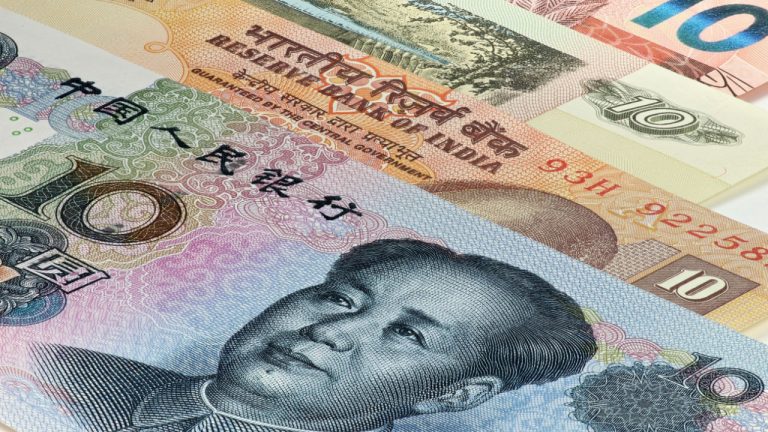
BRICS to Promote National Currencies Before Issuing Common One

BRICS to Promote National Currencies Before Issuing Common One

The BRICS bloc is now focused on expanding the use of the currencies of its members, according to the representative of one of them. The establishment of a single currency for the group is not an immediate task at this point in time, the diplomat indicated in an interview.

Wider Use of National Fiats of BRICS States to Precede Launch of Single Currency

Experts at BRICS are putting efforts into deepening ties between the economies and financial markets of its member states, with the aim of creating a common currency. However, its possible introduction is a medium-term and even longer-term task, South Africa’s ambassador to the organization, Anil Sooklal, told Russian media.

“Right now we are working on expanding the use of BRICS national currencies in mutual trade. BRICS has a corresponding agreement, and now we are implementing it in practice, so that the trade of the BRICS countries among themselves is increasingly based on our national currencies,” the top representative explained, speaking to the Tass news agency.

Sooklal emphasized that an increase in the use of national currencies in trade and investment should precede the creation of a single currency. Different scenarios related to trade and currencies are being considered at the moment, he pointed out and stated:

National currencies should be increasingly used by the BRICS states not only in trade, but also in investments and other transactions. Only this way can the foundation for the single BRICS currency be created.

Officials from the BRICS group of emerging economies — Brazil, Russia, India, China, and South Africa — are expected to meet in Cape Town, in early June. Anil Sooklal recently told Bloomberg that enlargement will be in the focus of their talks, with a total of 19 other countries showing interest in becoming members of the organization.

The idea to issue a common BRICS currency, which is supported by its current members who hope to use it to increase their influence and sidestep Western sanctions, has caused concerns in the United States that the dominant role of the U.S. dollar on the world stage will be undermined. The matter will be discussed at the next BRICS leaders’ summit in August.

Do you expect the leaders of BRICS nations to speed up the development of a single currency? Share your thoughts on the subject in the comments section below.


from Bitcoin News https://ift.tt/U6meGzM

Comments

Popular posts from this blog

Bitcoin ETFs Snap 10-Day Streak: $93M Flees as Fidelity’s FBTC Takes the Hit

Data compiled Friday revealed a striking reversal for spot bitcoin exchange-traded funds, which snapped a ten-session inflow streak with a $93.16 million exodus—marking their first day of negative movement. Bitcoin ETFs Drain While Ether ETFs Gain The abrupt shift punctuated a previously unbroken stretch of positive momentum for U.S. bitcoin ETFs, culminating in a $93.16 […] from Bitcoin News https://ift.tt/Q1xgKWA

Richard Teng Takes Charge as Binance CEO Following Changpeng Zhao’s Exit

After Changpeng Zhao’s exit, Richard Teng has stepped in as the new chief executive officer of Binance, the globe’s largest crypto exchange in terms of trading volume. On Tuesday, Teng made his introduction to the public through social media platform X, assuring that under his stewardship, Binance will “continue to meet and exceed the expectations of stakeholders.” Richard Teng Assumes Binance’s Top Role, Succeeding CZ This week marked a significant event for crypto enthusiasts as they observed one of the largest settlements in the industry’s history. The settlement involved Binance and the U.S. Department of Justice, with Binance incurring fines totaling approximately $4.3 billion. Following this development, the exchange’s CEO, Changpeng Zhao — popularly known as “CZ” — resigned. Post-settlement, on Tuesday, CZ announced via Twitter that Binance’s ex-Global Head of Regional Markets, Richard Teng, has been appointed as the new CEO. Teng brings an extensive history in the financ...

Glassnode and Ark Invest Introduce ‘Cointime Economics’ — A New Model to Measure Bitcoin’s Value

Researchers from Glassnode and Ark Invest have collaborated to develop a new economic model for analyzing Bitcoin’s onchain metrics called “Cointime Economics.” The framework offers an alternative way to measure the economic activity and value of bitcoin based on “coinblocks” rather than the standard accounting method of unspent transaction outputs, or UTXOs. Cointime Economics: A Unique Framework for Analyzing Bitcoin The Cointime Economics white paper explains that coinblocks are the product of the number of bitcoin, or BTC , multiplied by the number of blocks they are held without moving. For instance, ten bitcoins held for ten blocks would equal 100 coinblocks. This method aims to capture the real economic weight and importance of each bitcoin based on the time it remains dormant. The longer a bitcoin is unmoved, the higher its cointime and implied economic significance. Cointime Economics introduces metrics such as coinblocks created, destroyed, and stored to describe Bitcoi...