
Bitcoin Difficulty Surges 4.68%, Taps New All-Time High; Metric Set to Surpass 40 Trillion

Bitcoin Difficulty Surges 4.68%, Taps New All-Time High; Metric Set to Surpass 40 Trillion

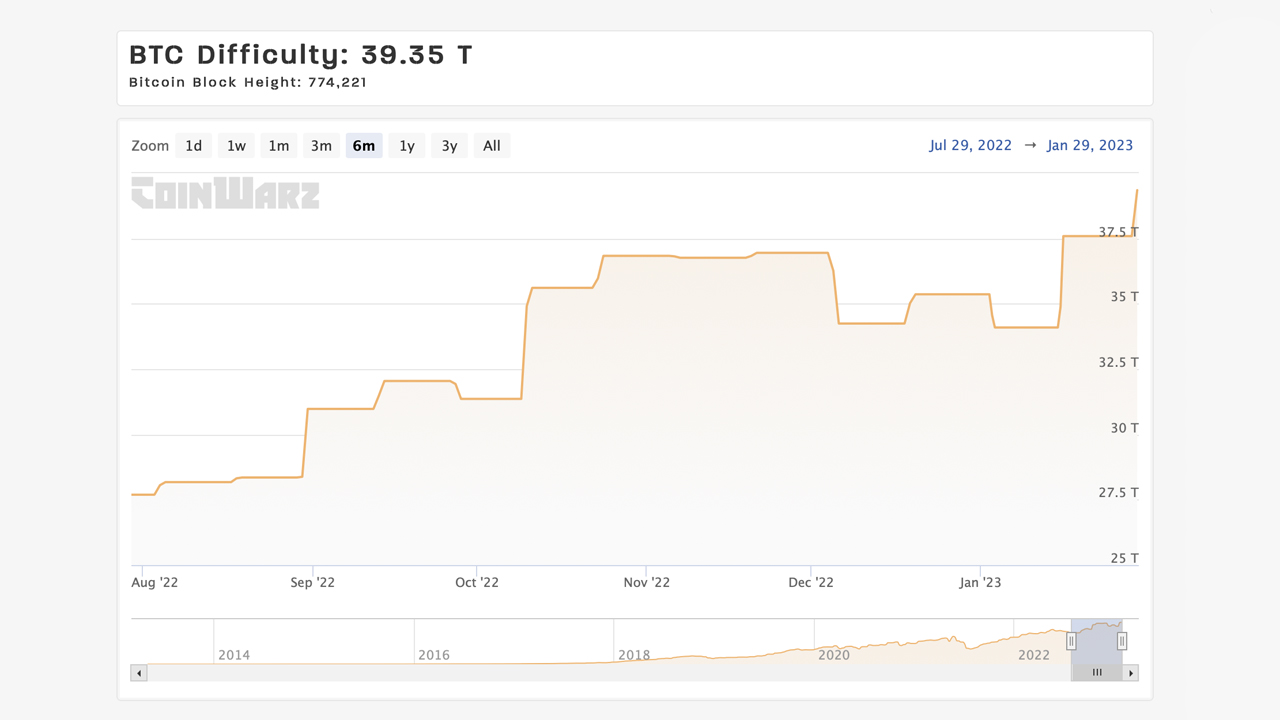
The Bitcoin blockchain recorded another difficulty increase on Sunday, Jan. 29, 2023, at block height 774,144. The network’s difficulty increased by 4.68%, from 37.59 trillion to an all-time high of 39.35 trillion.

Bitcoin Difficulty Reaches New All-Time High as Mining Gets Tougher

Bitcoin’s difficulty reached another all-time high, surpassing the record set two weeks ago, after rising 4.68% on Sunday. The increase occurred at block height 774,144, at 6:10 a.m. (UTC). The difficulty is now at 39.35 trillion, close to surpassing 40 trillion. The next adjustment is due Feb. 11, 2023.

Bitcoin Difficulty Surges 4.68%, Taps New All-Time High; Metric Set to Surpass 40 Trillion

The rise makes mining blocks more difficult, following a 4.68% jump after the 10.26% increase on Jan. 15, 2023. Jan. 29 statistics show a hashrate of 279.7 exahash per second (EH/s) over the last 2,016 blocks, currently at 283.55 EH/s dedicated to the Bitcoin blockchain.
Bitcoin Difficulty Surges 4.68%, Taps New All-Time High; Metric Set to Surpass 40 Trillion

Statistics from macromicro.me on Jan. 28, 2023, estimate the cost of BTC production at $21,176 per unit. On Jan. 29, the spot price was $23,584. With spot prices higher than the cost of production, bitcoin (BTC) miners have recouped some losses from the end of 2022.

Pool distribution calculated by blocks discovered shows Foundry USA as the top mining pool with 101.47 EH/s, equating to 34.89% of the network’s hashpower. Antpool has 57.54 EH/s, or 19.79% of the total network hashrate. F2pool, Binance Pool, Viabtc, Btc.com, and Braiins Pool follow Foundry and Antpool, respectively.

With the increase in difficulty, block intervals, or the time between each BTC block, have been about 9:02 to 9:38 minutes. This is slower than the recent 8:54 to 9:31 minutes recorded two days ago, but still faster than the 10-minute average.

What impact do you think the increasing difficulty of the Bitcoin network will have on miners and the cryptocurrency industry as a whole? Share your thoughts in the comments section below.


from Bitcoin News https://ift.tt/PhGNsfI

Comments

Popular posts from this blog

Ripple Donates $300K to Support Nepal and Tibet Flood Relief

Ripple is donating $300,000 to World Central Kitchen and Mercy Corps following devastating floods in Nepal and Tibet. The funding will support emergency meals, clean-water access, and sanitation efforts in affected communities. Ripple Directs $300K to Emergency Assistance A $300,000 Ripple donation will support emergency food, water, and sanitation assistance after destructive flooding struck Nepal […] from Bitcoin News https://ift.tt/b60CqSG

$13T Asset Manager Charles Schwab Adds 3 Altcoins to Its Crypto Push

There’s been a great deal of institutional interest in crypto assets over the last two years, and on Thursday, the $13 trillion asset manager Charles Schwab announced that it is expanding its digital asset listings beyond bitcoin and ethereum. According to the announcement, solana (SOL), avalanche (AVAX), and chainlink (LINK) accessibility will be added to […] from Bitcoin News https://ift.tt/b1dBkM5

Glassnode and Ark Invest Introduce ‘Cointime Economics’ — A New Model to Measure Bitcoin’s Value

Researchers from Glassnode and Ark Invest have collaborated to develop a new economic model for analyzing Bitcoin’s onchain metrics called “Cointime Economics.” The framework offers an alternative way to measure the economic activity and value of bitcoin based on “coinblocks” rather than the standard accounting method of unspent transaction outputs, or UTXOs. Cointime Economics: A Unique Framework for Analyzing Bitcoin The Cointime Economics white paper explains that coinblocks are the product of the number of bitcoin, or BTC , multiplied by the number of blocks they are held without moving. For instance, ten bitcoins held for ten blocks would equal 100 coinblocks. This method aims to capture the real economic weight and importance of each bitcoin based on the time it remains dormant. The longer a bitcoin is unmoved, the higher its cointime and implied economic significance. Cointime Economics introduces metrics such as coinblocks created, destroyed, and stored to describe Bitcoi...